
EP EuropaceIF 10.2
Circulating miR-10b-5p as a candidate biomarker of atrial fibrillation recurrence after catheter ablation: a two-phase translational study
View full article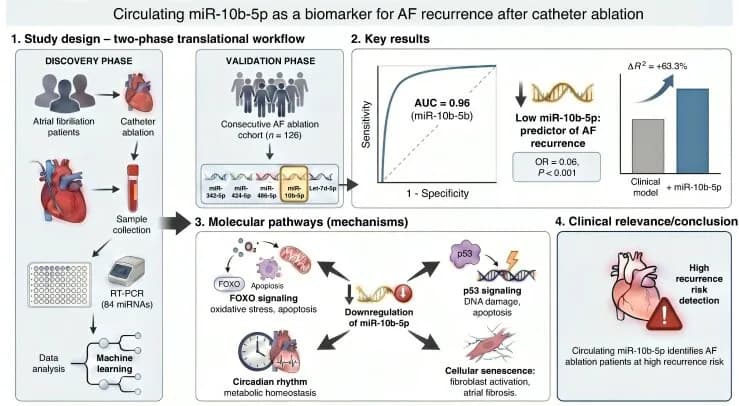
A Reward for Your Research
Used FigureLabs in a published paper? Acknowledge it and receive 1–3 months of Pro after verification.
See details
Abstract
The identification of reliable biomarkers for atrial fibrillation (AF) recurrence post-catheter ablation remains a clinical challenge. This study aimed to identify circulating microRNAs (miRNAs) associated with post-ablation AF recurrence and examine their underlying molecular pathways using an integrative translational approach. This two-phase study included a discovery case-control phase (n = 29) followed by a prospective validation cohort (n = 126). In the discovery phase, 84 miRNAs were quantified via real-time PCR, and candidates were selected using differential expression analysis and machine learning. In the validation phase, five candidate miRNAs (hsa-miR-342-3p, hsa-miR-424-5p, hsa-miR-486-5p, hsa-miR-10b-5p, and hsa-let-7d-5p) were further evaluated to assess their prognostic performance. Pathway enrichment analysis was performed for the most predictive miRNA. Differential expression analysis identified 14 miRNAs to be significantly associated with AF recurrence. In the validation cohort, hsa-miR-10b-5p showed the highest discriminative performance (AUC = 0.96, P < 0.001). Multivariable logistic regression confirmed that lower expression of hsa-miR-10b-5p was an independent predictor of recurrence (OR = 0.06, P < 0.001), significantly improving the baseline clinical model (ΔR = 63.3%). Pathway analysis linked hsa-miR-10b-5p to FOXO signalling, p53 signalling, circadian rhythm and cellular senescence, pathophysiologic mechanisms that are critical to atrial remodelling, and fibrotic persistence. Down-regulation of circulating hsa-miR-10b-5p was independently associated with AF recurrence after catheter ablation and improved risk discrimination beyond clinical variables. These findings support its potential role as a prognostic biomarker, although further multicentre validation is required before clinical application.