
Science AdvancesIF 13.9
IFNAR1 stabilization sustains CD8+ T cell persistence in IFN-high colorectal cancer liver metastases
View full article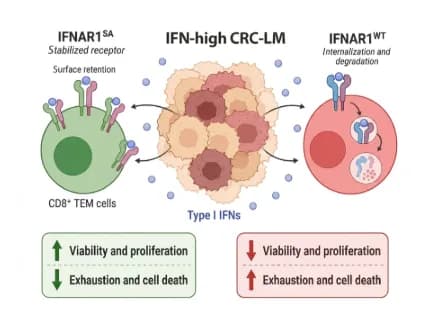
A Reward for Your Research
Used FigureLabs in a published paper? Acknowledge it and receive 1–3 months of Pro after verification.
See details
Abstract
Colorectal cancer liver metastases (CRC-LMs) are associated with poor survival and frequently resist immunotherapy, yet the mechanisms underlying this immune refractoriness remain incompletely defined. Here, we identify a tumor-intrinsic type I interferon (IFN-I)-high state in CRC-LMs associated with loss of the IFN-α/β receptor subunit 1 (IFNAR1) on effector T lymphocytes within immune-enriched perimetastatic niches. Reduced IFNAR1 expression stratifies patients with poor clinical outcomes. Transcriptional profiling of patient-derived organoids and complementary preclinical models revealed heterogeneous but recurrent tumor-derived IFN-I production in CRC-LMs. In IFN-Ihigh contexts, sustained signaling promoted IFNAR1 internalization on effector CD8+ T cells, impairing their persistence, survival, and effector function. Pharmacologic or genetic stabilization of IFNAR1 on cell surface restored CD8+ T cell fitness and selectively enhanced T cell receptor- and chimeric antigen receptor-based immunotherapies in IFN-Ihigh tumors. These findings define a context-dependent IFN-Ihigh/IFNAR1low axis that constrains antitumor immunity in CRC-LMs and identify IFNAR1 stabilization as a strategy to convert chronic IFN signaling from a suppressive barrier into a therapeutic vulnerability.