
ACS Measurement Science AuIF 14.7
Electrochemical–LSPR Multiplexed Immunoassay with a Multi-Analyte Index for Sepsis-Associated Biomarkers
View full article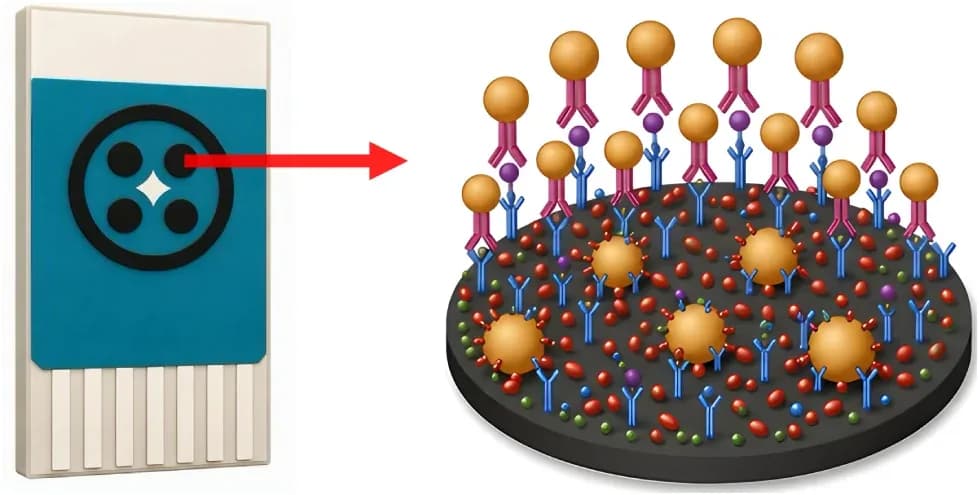
A Reward for Your Research
Used FigureLabs in a published paper? Acknowledge it and receive 1–3 months of Pro after verification.
See details
Abstract
Multiplexed immunoassays frequently face challenges associated with signal cross-reactivity, matrix effects, and the integration of analytes with disparate concentration ranges and transduction efficiencies. Here, we report an electrochemical multiplexed immunoassay implemented on a four-working-electrode screen-printed carbon electrode (4-WE SPCE) platform, which is complemented with localized surface plasmon resonance (LSPR). Distinct redox probes—methylene blue (MB), cysteine (Cys), and ruthenium hexamine chloride (RuHex)—were assigned to individual working electrodes, enabling parallel differential pulse voltammetry (DPV) measurements of three inflammatory biomarkers in phosphate-buffered saline (PBS) and 50% human serum. Blank samples were analyzed separately, and the nonzero calibration ranges were 0.5-20 ng mL-1 for procalcitonin (PCT) and 0.5-20 μg mL-1 for both C-reactive protein (CRP) and serum amyloid A (SAA). The bioassay demonstrated concentration-dependent current suppression, with calculated limits of detection (LoDs) of 0.0255 ng mL-1 for PCT, 1.60 μg mL-1 for CRP, and 0.0670 μg mL-1 for SAA in PBS, and 6.99 ng mL-1 for PCT, 0.0556 μg mL-1 for CRP, and 0.193 μg mL-1 for SAA in 50% human serum. Minimal cross-reactivity between biomarkers was observed, supporting analytical selectivity, while the measurements showed repeatability across replicate experiments (n ≥ 3). Gold nanoparticle (AuNP) surface engineering enhanced electron-transfer kinetics and antibody immobilization, producing analyte-specific electrochemical signatures. Complementary LSPR measurements provided an orthogonal optical readout that offered evidence of antibody-antigen binding at the plasmonic interface, strengthening confidence in assay specificity and performance. To support multiplexed signal integration, a dimensionless multianalyte index (MAI) based on normalized concentrations was introduced as a proof-of-concept analytical framework for combining heterogeneous biomarker signals. This MAI framework enables standardized interpretation of multiplexed electrochemical measurements using sepsis-associated inflammatory biomarkers, highlighting its potential applicability to broader multiplexed immunoassay platforms.