
Ageing Research ReviewsIF 15.5
The silent infection load: How lifelong asymptomatic infections may contribute to inflammaging as an evolutionary trade-off of longevity
查看全文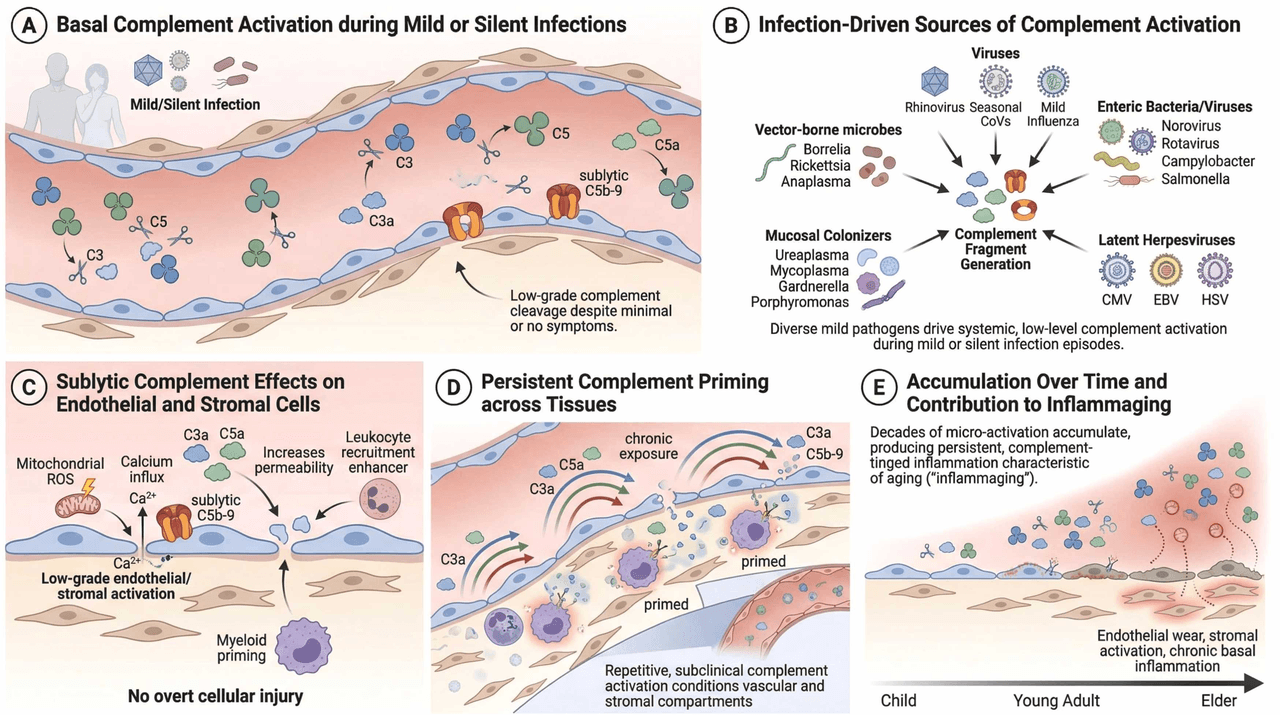

摘要
Asymptomatic infections are traditionally considered harmless, reflecting effective immune control and the absence of clinical disease. Yet growing evidence shows that these silent encounters with microbes are far from being immunologically neutral. Throughout life, humans are challenged by a remarkably broad spectrum of viruses and bacteria, including latent pathogens that persist, fluctuate, or periodically reactivate without producing significant symptoms. From an evolutionary standpoint, this represents a fundamental trade-off. Long-lived hosts benefit from maintaining diverse commensal, latent, and low-grade persistent microbes that enhance immune readiness, promote cross-protective immunity, and reduce vulnerability to severe infections. However, this adaptive advantage is counterbalanced by the continuous burden of chronic, almost undetectable immune activation and inflammation, and by the energetic cost of sustaining such mechanisms of surveillance. In this regard, retroviral integrations provide a striking illustration of how persistent viral presence has shaped the evolution of complex organisms by introducing new regulatory elements, immune modulators, and developmental programs. These ancient viral imprints demonstrate that clinically-silent host-microbe interactions can exert long-term selective pressures and influence species-specific biological trajectories. At the individual level, repeated asymptomatic infections trigger transient waves of immune activation, endothelial perturbation, mitochondrial stress, and complement engagement. Although each episode is mild and self-limited, their cumulative burden generates micro-damage that accelerates immunosenescence, perturbs metabolic and vascular homeostasis, and contributes to the progressive rise in systemic inflammation characteristic of aging. Notably, in the context of the recent pandemics of SARS-CoV-2 infection, the emergence of Long COVID has highlighted how even clinically mild or initially asymptomatic infections can leave durable immunological, metabolic, and neurological traces, reinforcing the concept that “silent” infections may have lasting consequences.